The challenge
Ground teams reconcile timing, service readiness, and blockers while departures remain time-critical.
01 / HERO & PRODUCT SHOWCASE / AMERICAN AIRLINES / GROUND OPERATIONS
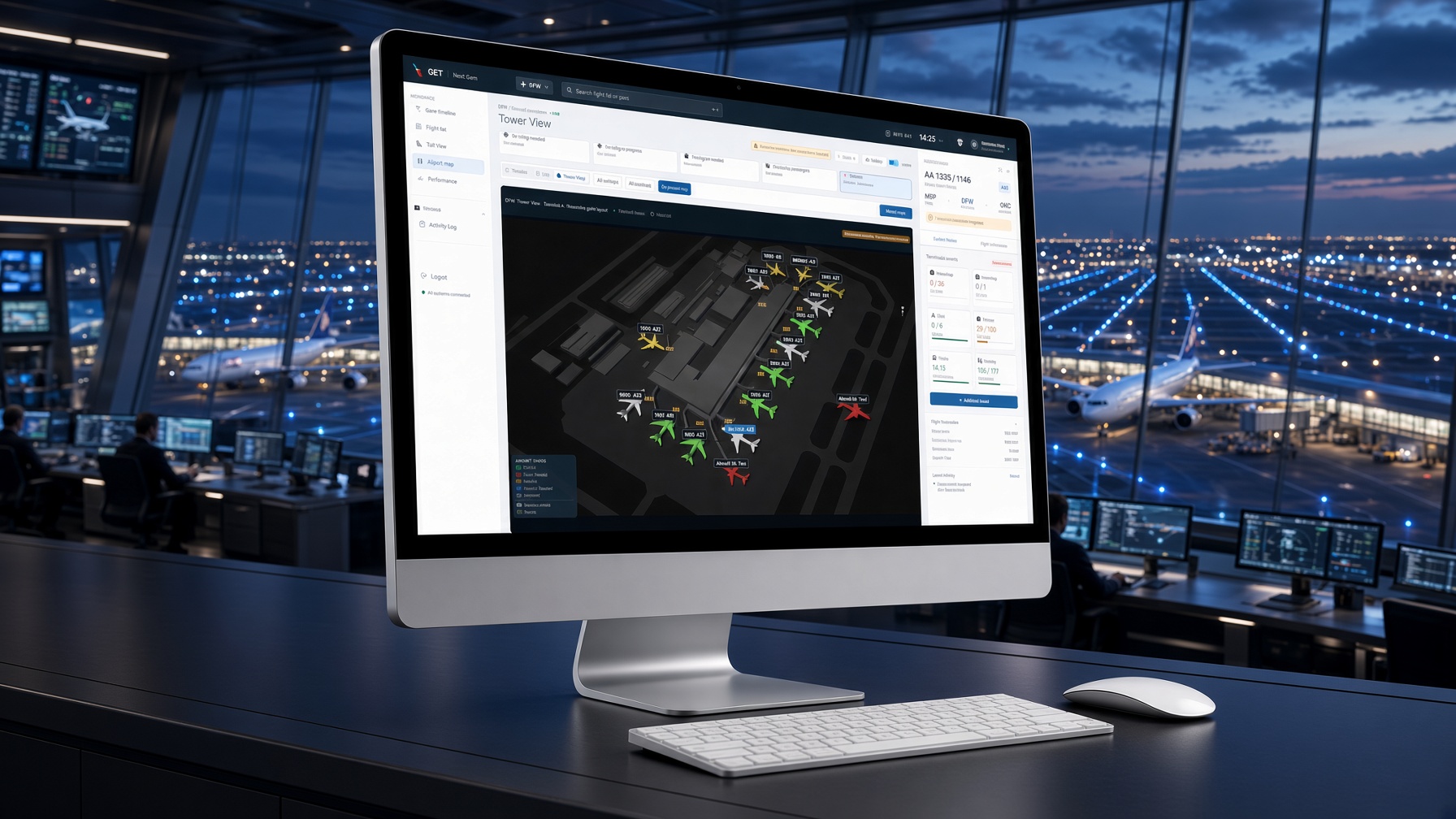
Connecting gate schedules, aircraft context, and turnaround readiness so ground-operations teams can see risk and coordinate the next action.
02 / EXECUTIVE SUMMARY
THE PROJECT IN 30 SECONDS
Ground teams reconcile timing, service readiness, and blockers while departures remain time-critical.
Connect temporal scheduling, spatial context, and flight-level detail in one operational workspace.
A documented interface and coordination direction, with a measurement framework. Measured turnaround improvement is not established by the supplied materials.
03 / PROBLEM & OPPORTUNITY
A gate coordinator needs to understand concurrent flights, service progress, and emerging blockers while working with ramp teams, the flight deck, and station leadership. A schedule alone explains timing; it does not explain every dependency behind a departure.
Separate station-wide health from flight-specific exceptions so a coordinator can scan, prioritize, and then inspect.
Bring gate occupancy and spatial aircraft context together without losing the selected flight or its turnaround details.
Keep service readiness, operational events, and the flight-deck conversation connected to the turn they affect.
04 / DISCOVERY & INSIGHTS
The workflow and interface materials reveal three design dependencies. These observations come from the supplied artifacts; interview quotations and usability-test results are not included.
Insight: Timing needs a shared reference.
Design implication: Align gate lanes on one time axis.
Insight: One status cannot explain overall readiness.
Design implication: Keep bags, crew, cabin, fueling, and doors distinct.
Insight: An alert needs an owner, estimate, and confirmation.
Design implication: Connect exception diagnosis to the flight-deck exchange.
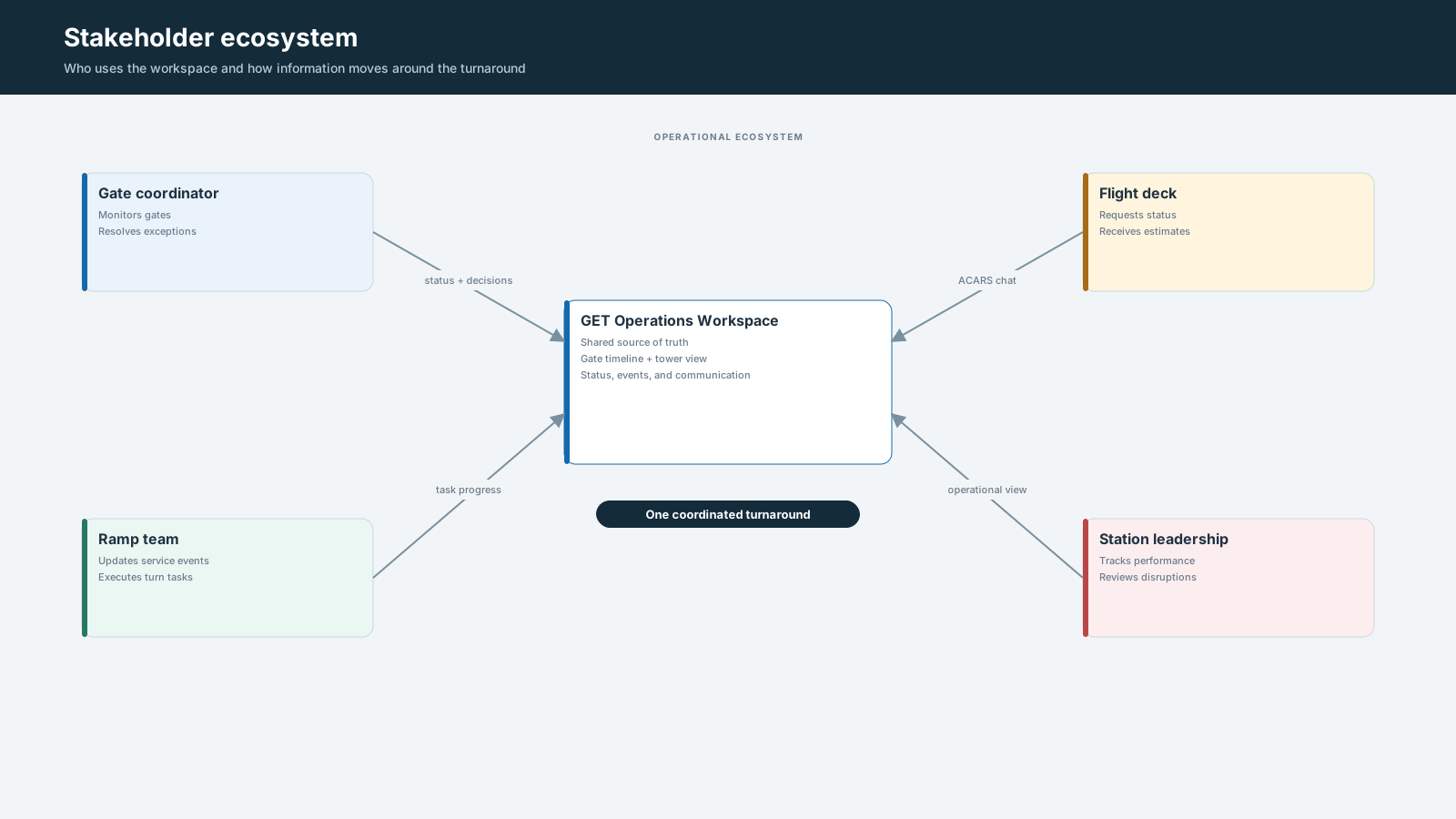
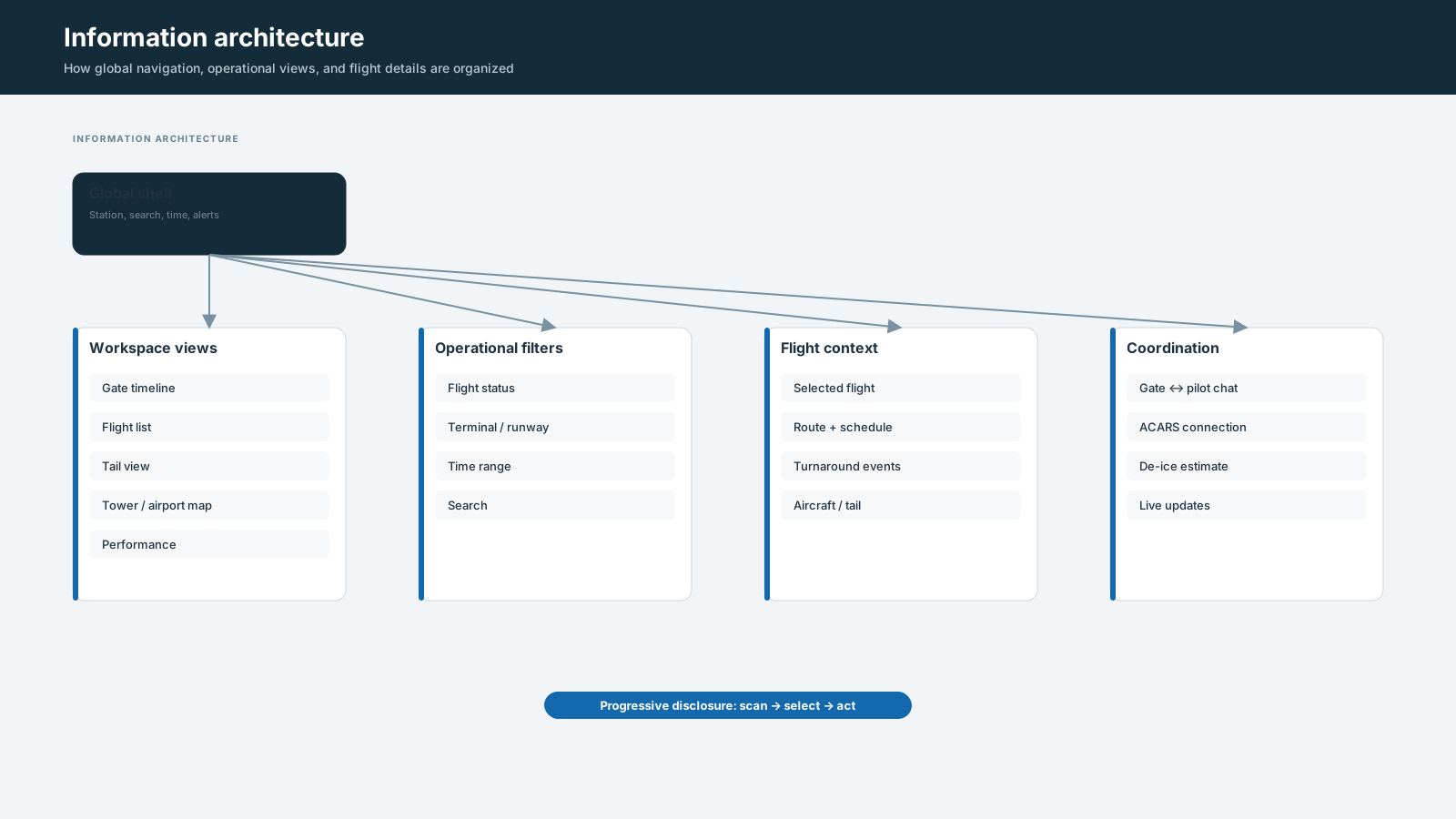
The operating model connects gate coordinators, ramp teams, the flight deck, and station leadership. The information architecture separates a persistent station shell from workspace views, flight context, filters, and coordination tools.
05 / STRATEGY & DESIGN DECISIONS
06 / ITERATIONS & VALIDATION
The available artifacts document visual states and intended coordination flows, rather than a dated iteration history or completed usability study. A verified legacy comparison and before-and-after test results have not been supplied.
Inspect selected-flight identity, service readiness, and blocker ownership across views.
Evaluate priority identification, exception diagnosis, and estimate sharing with representative coordinators.
Measure task times and errors before attributing operational improvements to the redesign.
07 / FINAL EXPERIENCE
Station health and complementary time and spatial views.
Exception filters and service-specific selected-flight detail.
Flight-linked dependencies, estimates, and follow-up.
PRODUCT CAPABILITIES / INTERFACE STUDIES
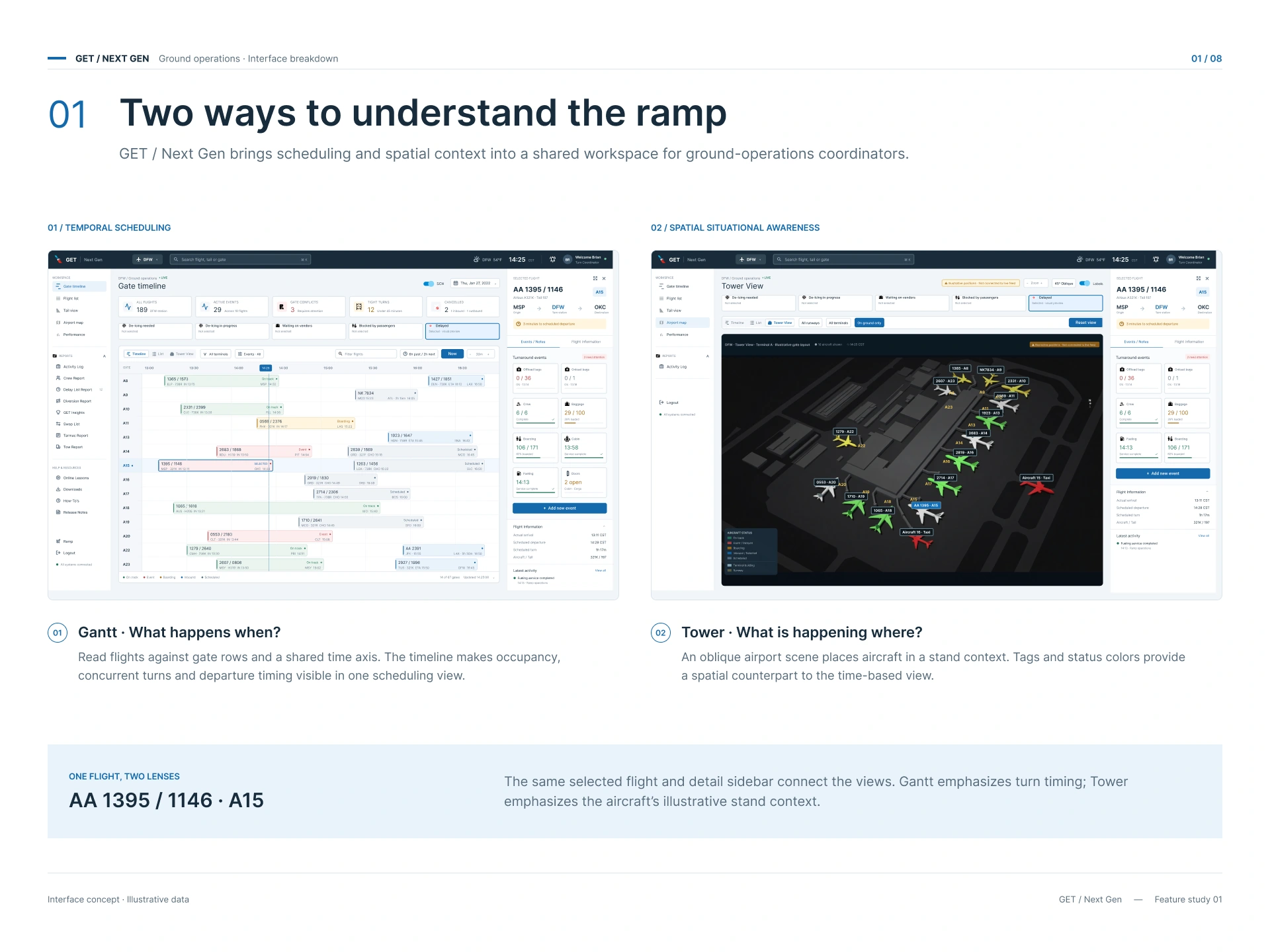
The gate timeline answers what happens when; Tower View answers what is happening where. Both retain the same selected-flight context.
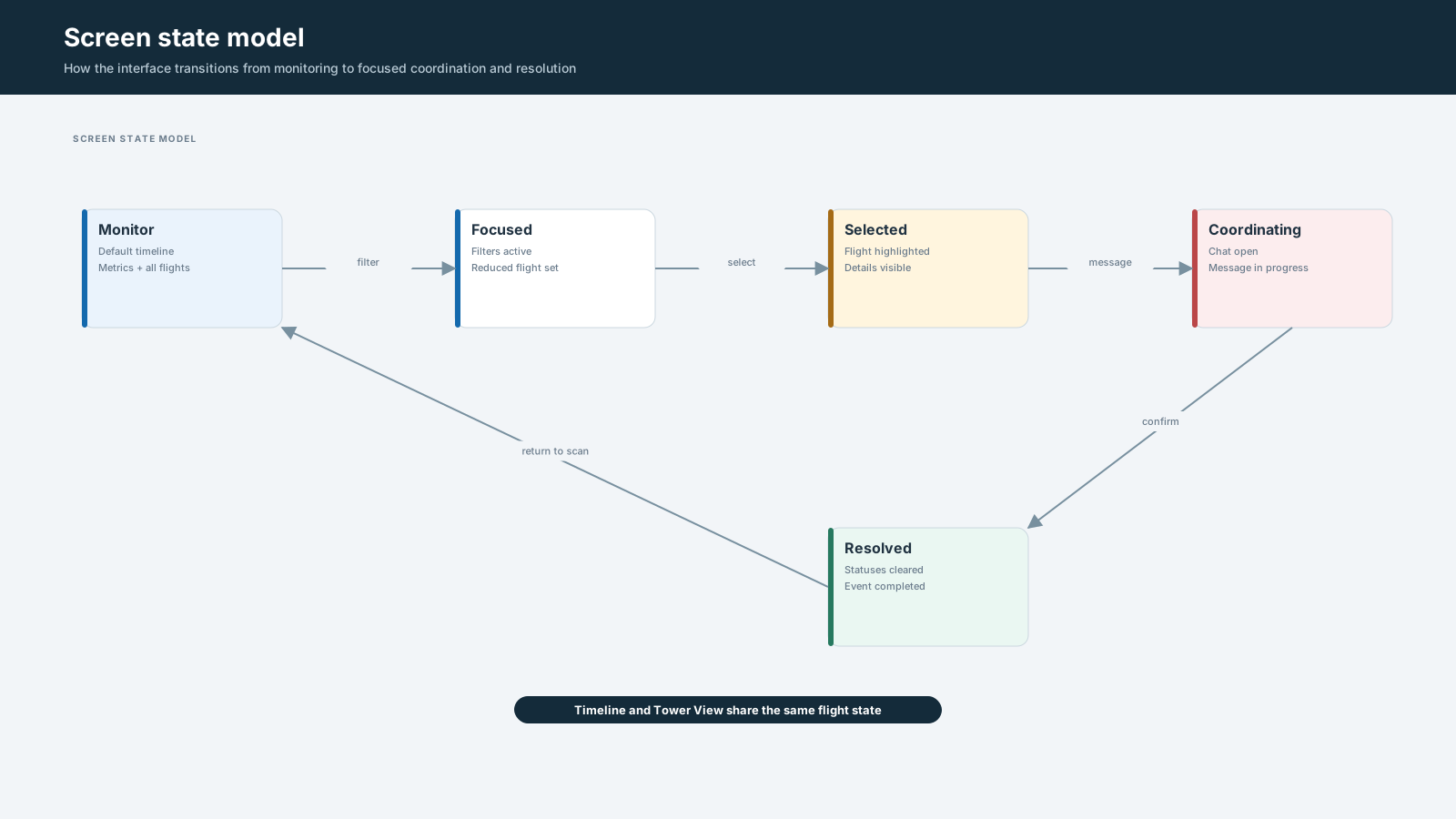
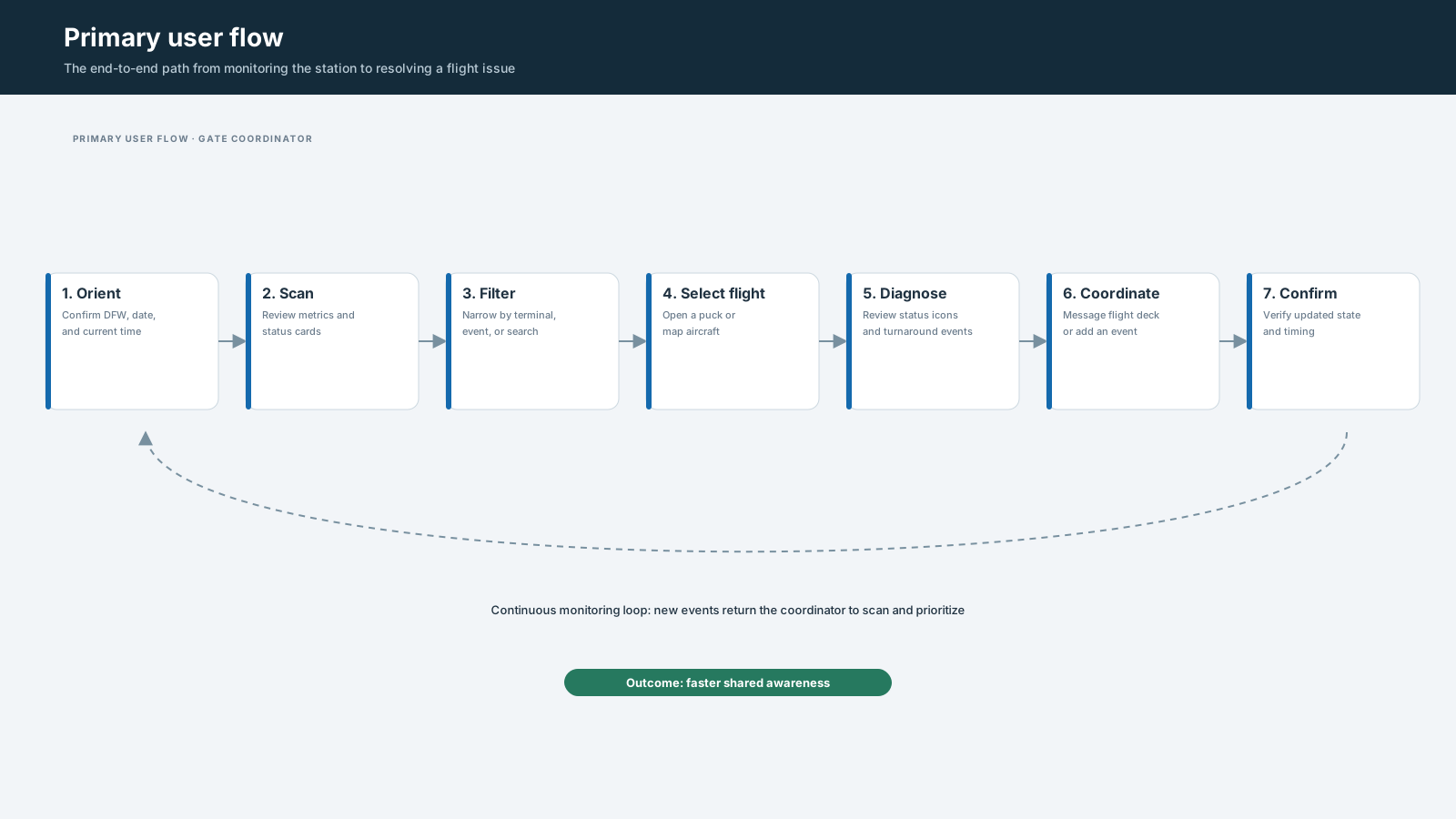
The primary workflow moves from station orientation to a focused flight and back to monitoring. Exceptions require more than a single status: a de-icing queue, a passenger blocker, and a delay can affect the same turn at once.
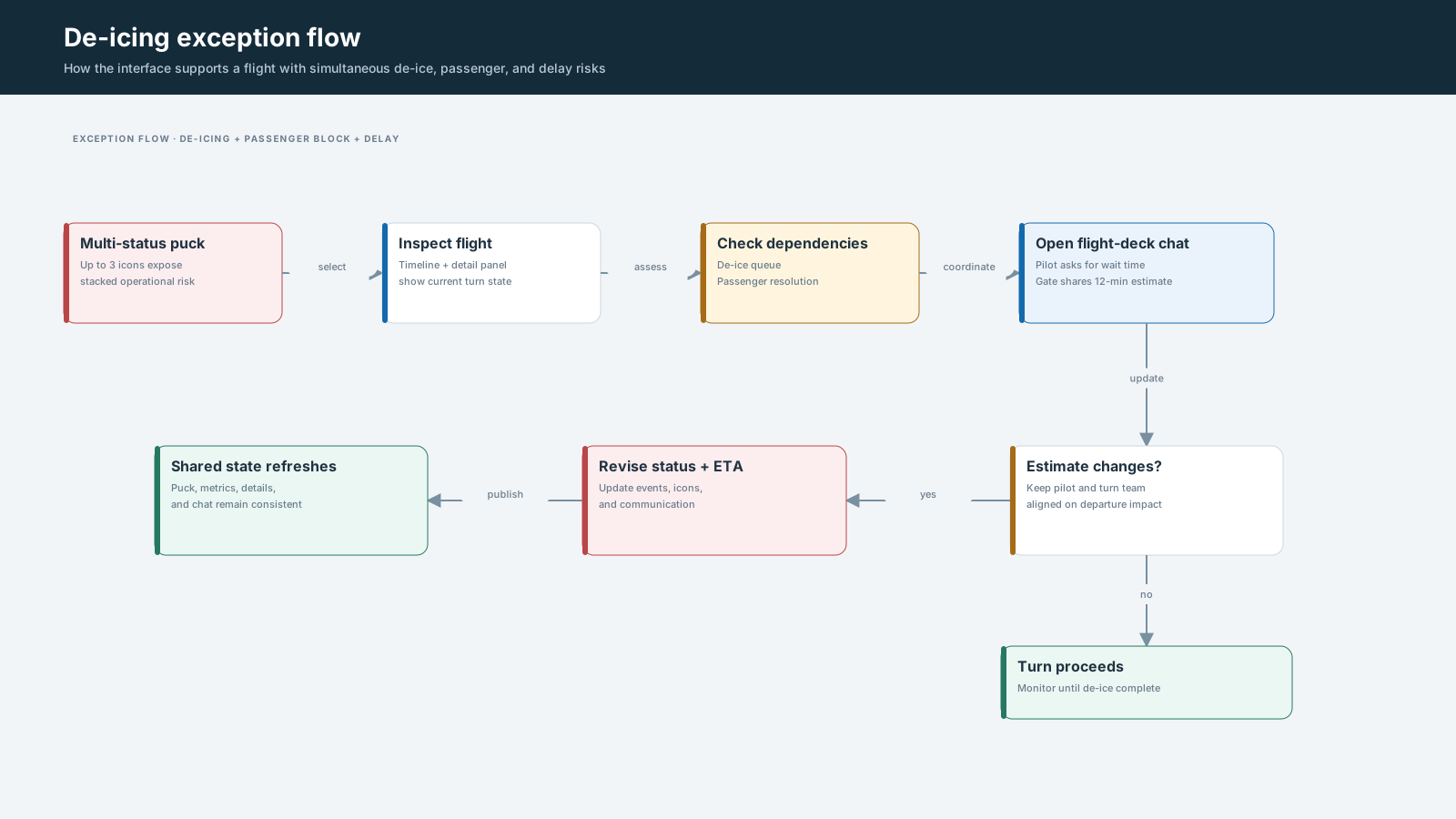
The de-icing scenario makes the coordination need concrete: inspect the turn, check dependencies, obtain an estimate, share it with the flight deck, and revise the shared state when conditions change. The 12-minute estimate in the diagram is a scenario value.
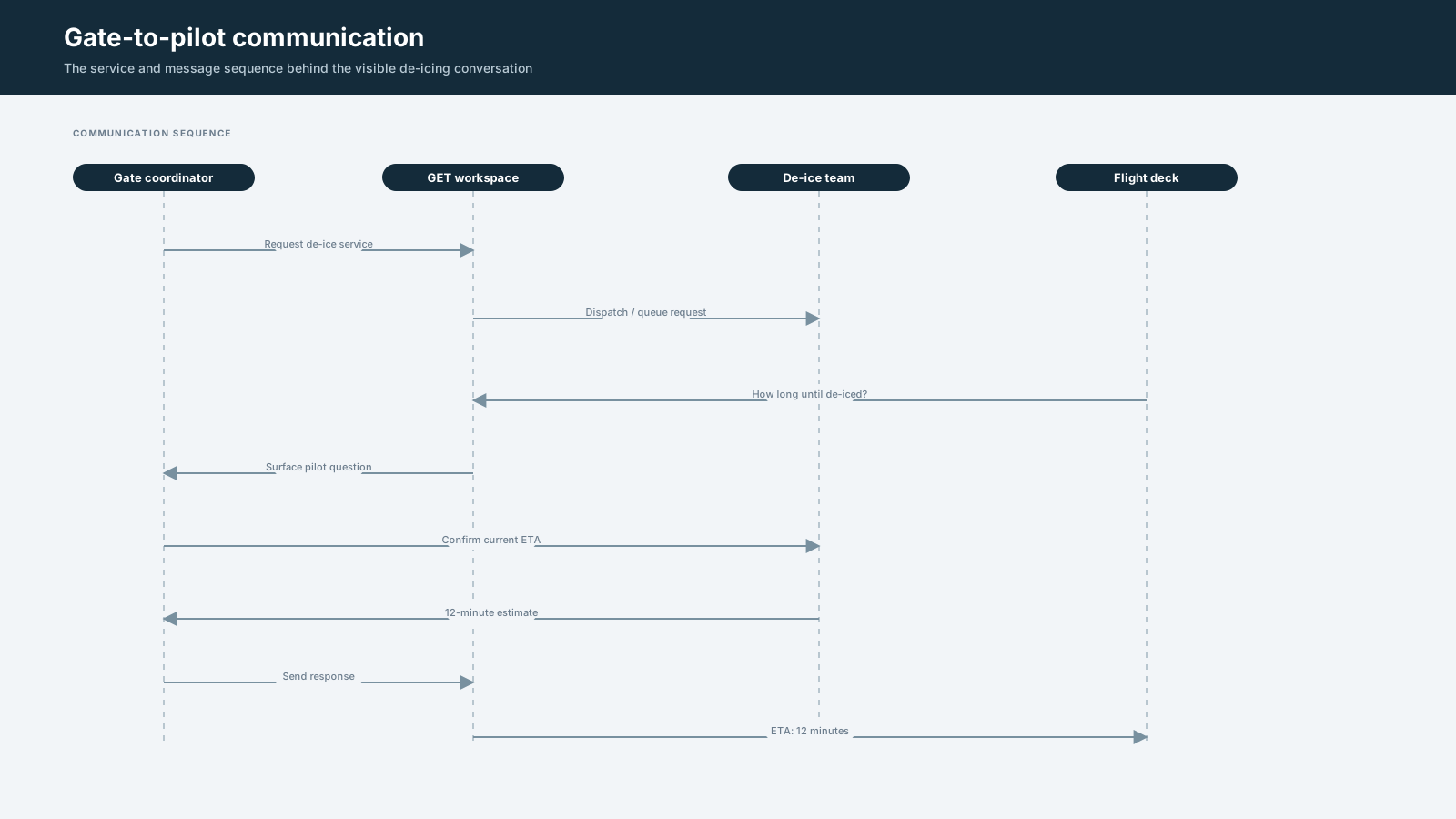
Cross-view filtering and coordination transitions are intended behavior. Tower View positions and gate geometry are illustrative.
08 / OUTCOMES & IMPACT
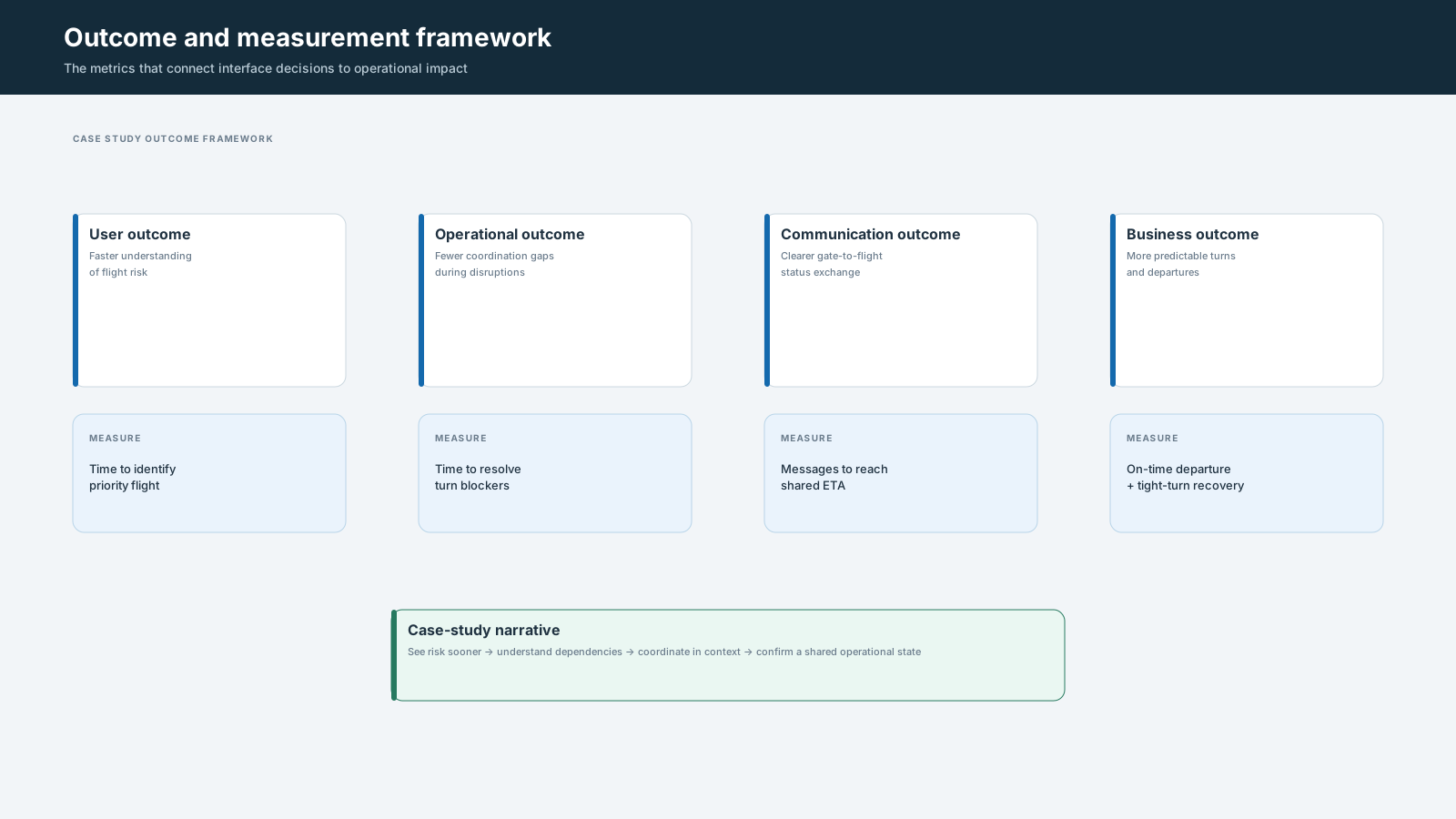
Risk, dependencies, and next actions remain connected. Task efficiency has not been measured in the available materials.
Evaluate blocker resolution and tight-turn recovery against an operational baseline. No causal turnaround reduction is claimed.
Eight annotated interface studies with architecture, workflow, state, and measurement diagrams.
The design direction is a shared operational view that helps teams identify risk, understand dependencies, coordinate in context, and confirm an updated state. The supplied outcome framework defines how to evaluate that direction; it does not report measured results.
Keep the broad operational picture and the actionable detail connected. Gantt explains when, Tower View explains where, and the selected-flight context explains what needs attention next.
09 / REFLECTION & NEXT STEPS
Gantt explains when, Tower View explains where, and selected-flight context explains what needs attention. The design judgment is preserving those relationships without forcing every detail into the monitoring view.
Next, validate station scanning and exception resolution with coordinators, then use observed task performance to refine density, status language, and cross-view behavior.