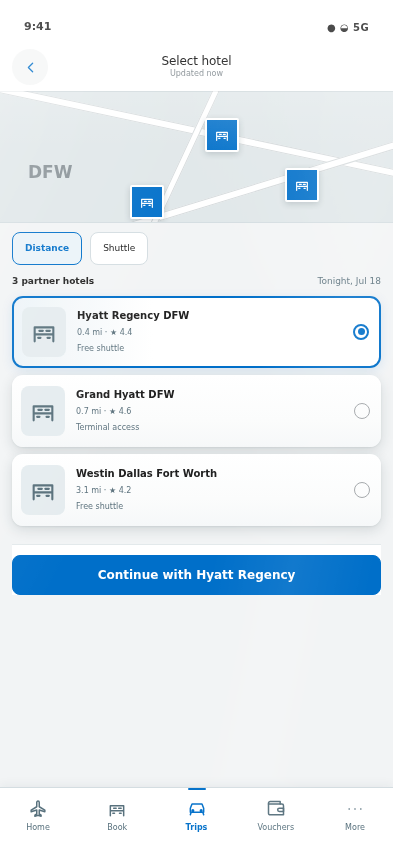
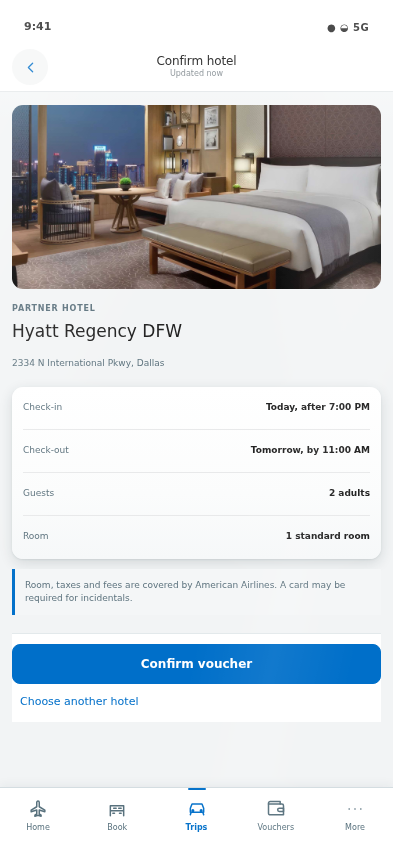
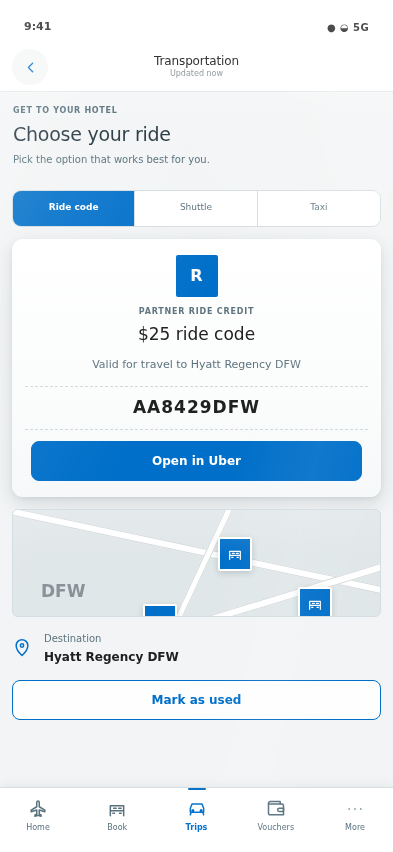
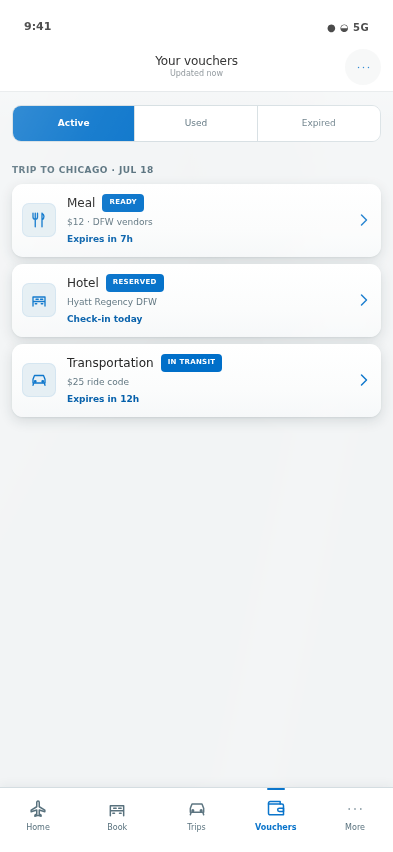
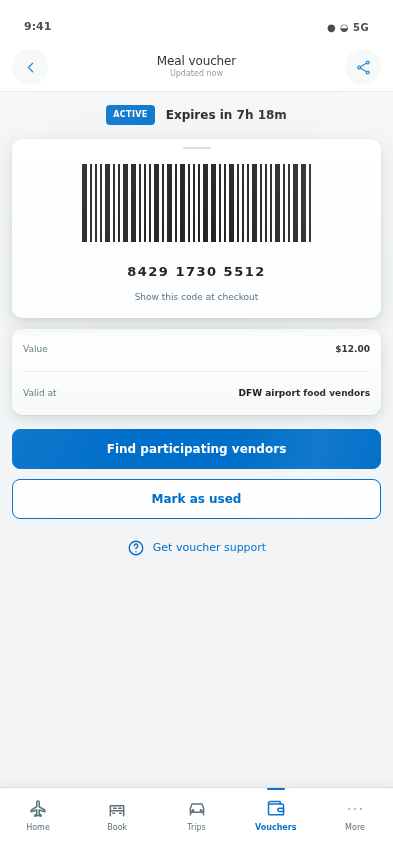
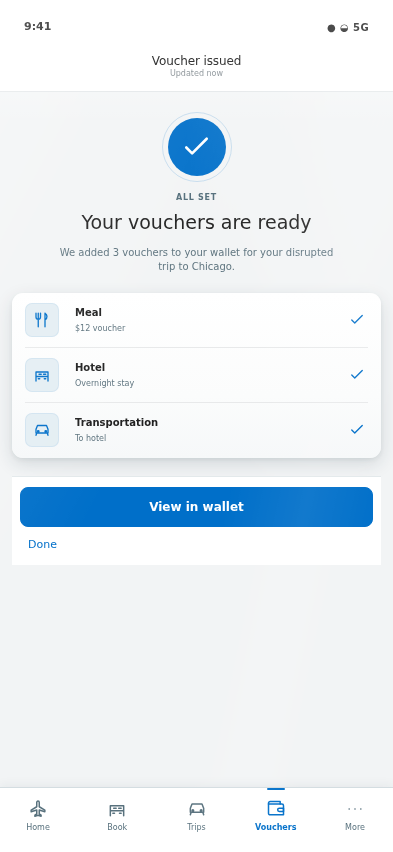
An enhanced disruption module within the American Airlines app, from eligibility to accommodation and an active voucher wallet.
Role
Lead UX Designer
02 / EXECUTIVE SUMMARY
From paper vouchers to help inside the trip.
THE PROJECT IN 30 SECONDS
Industry
Aviation / service experience
Role
Lead UX Designer
Platform
American Airlines mobile app
Focus
Disruption assistance
The challenge
The paper-based voucher process created friction for customers and the teams helping them during flight disruptions. The opportunity was to replace that manual process with a digital experience that made eligibility, next steps, and issued vouchers easier to understand and access.
The approach
Connect trip alerts, eligibility, hotel selection, claims, and the wallet within the American Airlines app.
The impact
A connected digital journey illustrated through ten high-fidelity screens and a click-through experience. No quantitative impact is claimed.
03 / PROBLEM & OPPORTUNITY
Reduce the burden of an already stressful moment.
Before HMT, the hotel, meal, and transportation voucher process was paper-based and inefficient. Customers affected by delayed or cancelled flights relied on a manual process to access eligible accommodations. HMT was created to digitize and streamline that experience within the American Airlines app, bringing eligibility, voucher claims, and issued vouchers into one connected flow.
Who it serves: American Airlines customers with delayed or cancelled flights, especially travelers facing a controllable disruption or an overnight stay away from home.
Digitize and streamline the legacy paper-based voucher process within the American Airlines trip experience.
Build within the American Airlines app’s trip details and disruption hub.
Reduce customer stress with a clear, reassuring experience during an already stressful flight disruption.
Keep navigation minimal and simple so customers can reach help and use vouchers with as few steps as possible.
Expand the existing American Airlines design system to support disruption-specific needs while maintaining a familiar experience.
Make controllable and non-controllable eligibility states explicit; avoid unsupported performance claims.
04 / DISCOVERY & INSIGHTS
Connect each observation to a design implication.
Trip-to-hub workflow mapping, user interviews, and an AA design system review connected navigation pain points, customer frustrations, and system gaps to the new voucher experience.
METHOD / 01
Trip-to-Hub Workflow Mapping
Observations
Selecting the affected trip and reaching the disruption options needed a clearer, more direct path.
Hotel selection needed to keep availability, location, and transportation details together so customers could make a decision without navigating back and forth.
Design implication: Keep trip entry direct and hotel, location, and transport information together.
METHOD / 02
User Interviews
Observations
Customers were frustrated by the inefficient paper-based voucher process during an already stressful flight disruption.
Uncertainty about eligibility, how to claim assistance, and where to find issued vouchers added friction when customers needed clear next steps.
Design implication: Show eligibility, the next claim action, and issued vouchers without making travelers reconstruct the process.
METHOD / 03
AA Design System Review
Observations
The existing American Airlines design system needed to be expanded to accommodate the new disruption flows, including eligibility, hotel selection, voucher claims, and wallet states.
New patterns needed to remain consistent with familiar AA navigation and interaction conventions.
Design implication: Extend familiar AA patterns for eligibility, selection, claims, and wallet states.
Research scope and supporting detail
The case-study account identifies workflow mapping, user interviews, and design-system review. Participant counts, transcripts, and a formal test report are not included in the supplied materials.
05 / STRATEGY & DESIGN DECISIONS
Make the trade-offs visible.
The rationale below explains the design direction and its constraints. It does not imply that every alternative was formally tested.
DECISION / 01
Start inside the disrupted trip
Tension
Travelers need help quickly while retaining the flight context.
Options & constraints
A separate app would add discovery and navigation effort during a disruption.
Design direction
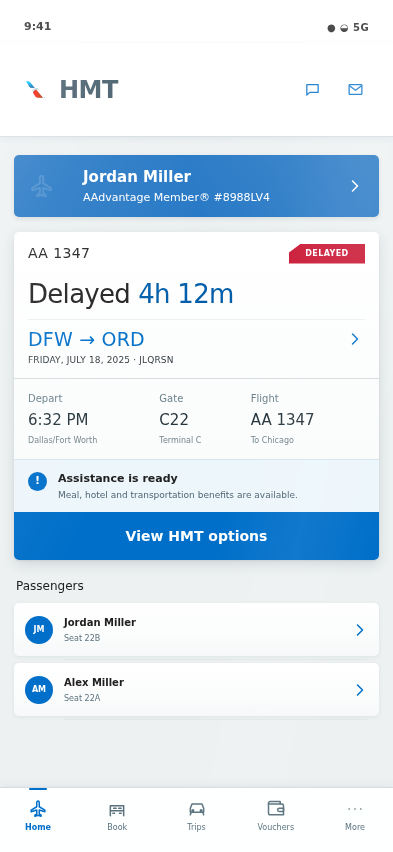
Enter through the flight alert and trip banner, then open the disruption hub.
Trade-off
The module stays familiar, but must fit existing AA navigation and trip states.
DECISION / 02
Branch only for meaningful choices
Tension
Hotel selection requires a decision; claiming a meal should be direct.
Options & constraints
One uniform claim form would add steps to simple benefits or omit hotel details.
Design direction
Use direct or bulk claims where appropriate, with a dedicated hotel selection and confirmation path.
Trade-off
Different branches require consistent eligibility, recovery, and confirmation patterns.
DECISION / 03
Keep issued help within reach
Tension
A successful claim is only useful if the traveler can find and redeem it.
Options & constraints
Separate confirmation pages can leave customers searching for codes later.
Design direction
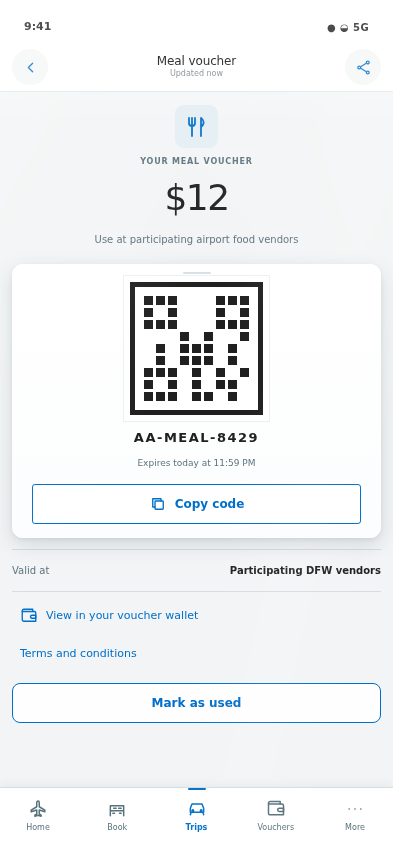
Make vouchers accessible from trip context and the Vouchers tab with expiry and next actions.
Trade-off
Wallet states need to remain consistent with claim, expiry, and partner redemption behavior.
Read the detailed design rationale
Start inside the trip
Use a push notification or in-app trip banner to enter the disruption hub. Preserve the familiar American Airlines navigation and trip context rather than introducing a separate product.
Explain eligibility before asking for action
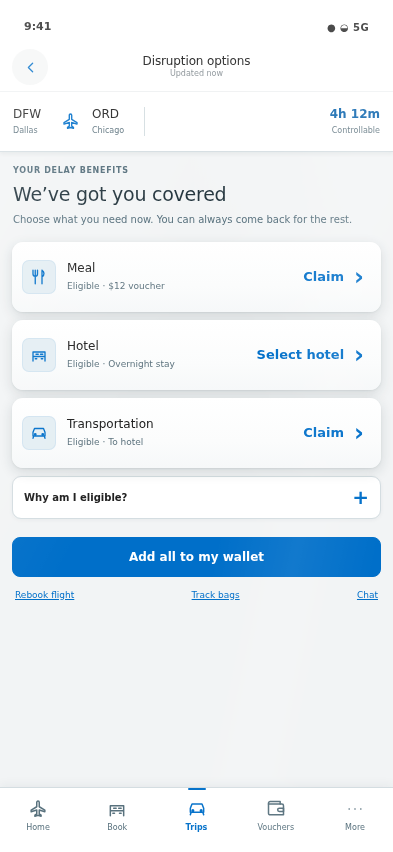
Summarize eligible hotel, meal, and transportation support with an on-demand rules explanation. The design scenario uses a roughly three-hour controllable delay for meals, and an overnight stay away from home for hotel and transport. These are scenario assumptions to validate against current airline policy, not a universal entitlement.
Branch only when a choice is needed
Offer one-tap or bulk claims where appropriate. Hotel support branches into selection and confirmation; meals lead to a voucher and redemption; transportation leads to a ride code, shuttle, or taxi option.
Keep the wallet close
Make active vouchers reachable from trip details and the Vouchers tab. Show codes, expiry, terms, and next actions. Offline access and automatic issuance for eligible AAdvantage members are proposed capabilities requiring further validation.
Design for the exception
For non-controllable disruptions, explain ineligibility and offer rebooking, refund, and self-service paths. The expanded design scope includes no-inventory reimbursement, expired or used states, history, and support; these remain part of the expanded design scope.
06 / ITERATIONS & VALIDATION
Review the journey, then validate it under pressure.
The supplied materials show the refined ten-screen flow and a click-through experience. They do not include dated early explorations or a formal before-and-after usability study.
DESIGN DIRECTION
Paper to digital
Replace the manual voucher process with eligibility, claims, and issued vouchers in one trip journey.
TO VALIDATE
Confidence at each handoff
Test claim completion, hotel selection, wallet retrieval, and recovery during a simulated disruption.
EVIDENCE NEEDED
Task-level results
Capture completion, errors, time, and qualitative feedback against a documented baseline.
07 / FINAL EXPERIENCE
From disruption to resolution.
INTERACTIVE DESIGN DEMO / HMT
Try the journey.
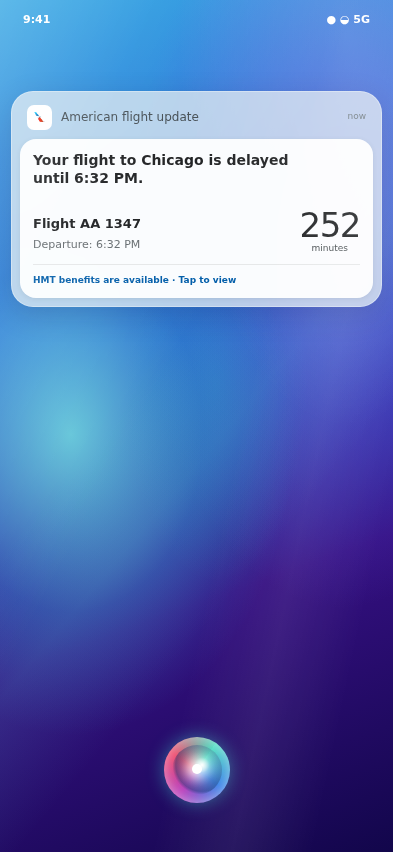
Explore the hotel, meal, and transportation design flow. Flight, hotel, and voucher information in this walkthrough is illustrative. Start with a lock-screen flight alert, open trip details, review eligible support, and find claimed vouchers in the wallet.
THE FLOW / INSIDE THE AA APP
Help, in the context of the trip.
01Trip alert
Delay or cancellation banner opens the disruption hub.
02Eligibility
Clear benefit status, reason, and rules on demand.
Active codes, expiry, partner actions, and support.
Expanded design scope
Non-eligible states, no-inventory reimbursement, history, offline access, and automatic issuance are proposed extensions. The interactive walkthrough focuses on the core claim flow.
CLICK THROUGH THE DISRUPTION MODULE
Tap the lock-screen flight alert to open the disrupted trip.
Open the disruption options.
Explore meal, hotel, and transportation benefits.
View the vouchers in the wallet.
Use the familiar trip navigation, back arrows, and Vouchers tab. Follow the journey from a disrupted trip to claimed vouchers in the wallet.
A connected journey, with impact still to measure.
USER VALUE
Help within reach
The design connects eligibility, benefit claims, and voucher retrieval. Stress reduction and completion efficiency remain intended benefits, not measured results.
BUSINESS IMPACT
Not quantified
No measured savings or operational reduction is established for this case study.
DELIVERED
Ten connected screens
The experience connects trip details, the disruption hub, voucher claims, and the wallet in one digital journey. Ten high-fidelity screens show hotel selection, meal vouchers, transportation, and issuance confirmation. No quantitative results are claimed.
09 / REFLECTION & NEXT STEPS
Design for the moment the plan breaks.
The opportunity is to reduce ambiguity and effort at the moment of disruption while preserving the existing app’s navigation, visual language, and policy constraints.
Next, test the core journey with disrupted travelers and evaluate exception paths such as no hotel inventory, expired vouchers, and recovery from an interrupted claim. Expand the existing design system around observed needs.